
EWC Think Tank
The Hellenic Economy: a five-year outlook, 2026 to 2030.

EWC RESEARCH AUTHORSHIP
Nikolaos Kolettis
Researching digital markets through structure, discipline, macro awareness, institutional adoption, and long-term financial transformation.
EWC THINK TANK 2026
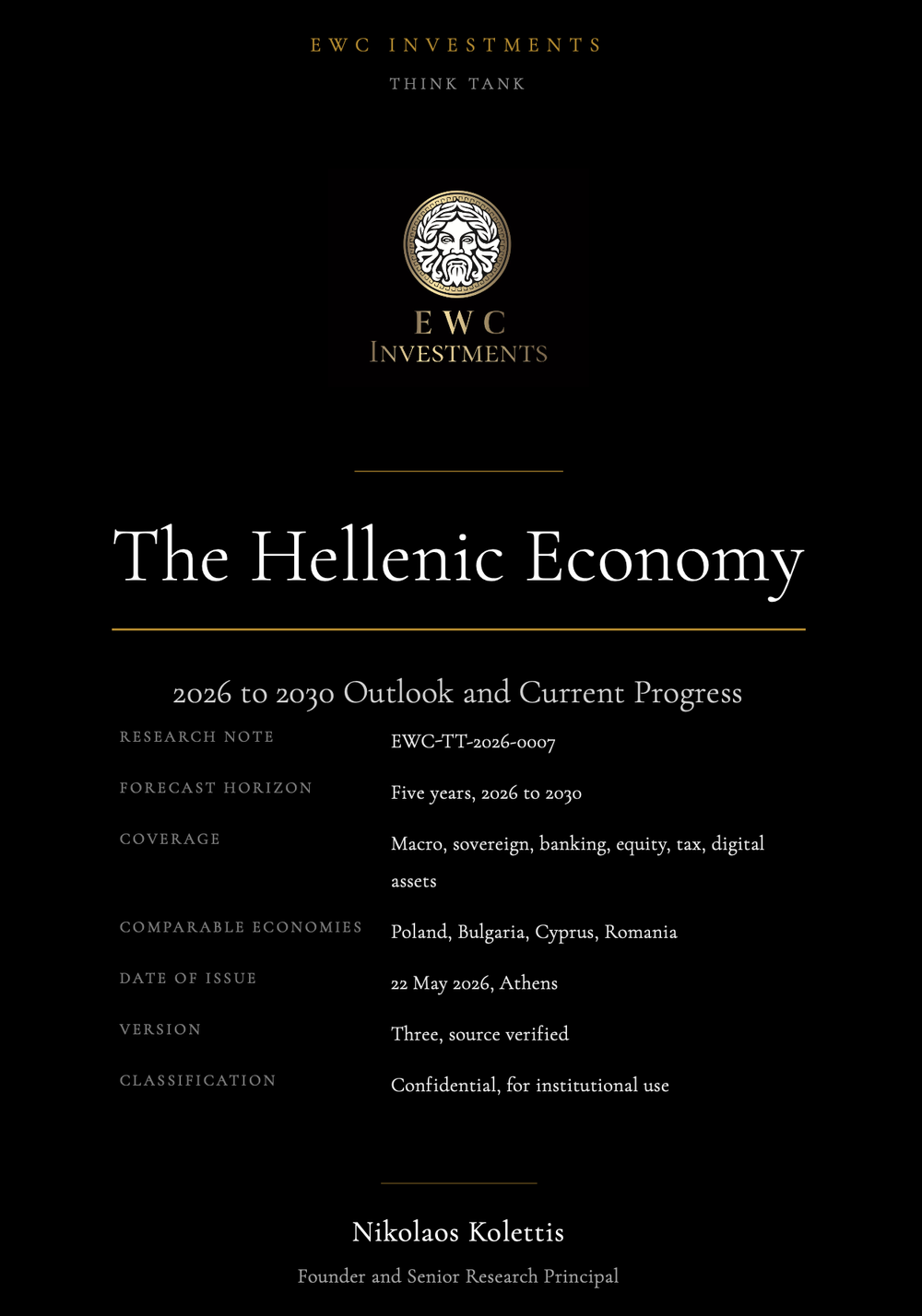
The Hellenic Economy: 2026 to 2030 Outlook and Current Progress
This research note examines the current trajectory of the Hellenic economy and its medium-term outlook from 2026 to 2030, with emphasis on macroeconomic progress, sovereign positioning, banking-sector development, investment conditions, taxation, and digital asset adoption.
The study places Greece within a comparative European framework, examining comparable economies including Poland, Bulgaria, Cyprus, and Romania, in order to evaluate structural progress, competitiveness, and realistic convergence potential.
The objective is to separate political noise and short-term optimism from measurable structural reality, offering a source-verified institutional overview of Greece’s economic direction and investment landscape.
The research note is publicly available through Zenodo and Academia.edu for reference, citation, and academic visibility.

EWC THINK TANK 2026
Research Outputs in a Glance
Six institutional research lenses for understanding the 2026 to 2030 Hellenic economy: macro outperformance, fiscal repair, sovereign re-rating, banking normalization, capital-market integration, tourism strength, structural constraints, and digital asset adoption.

Macro Outperformance
Greece enters the 2026 to 2030 window from a materially stronger macro base, with growth outpacing the eurozone, record tourism, rising investment flows, and a recovery built on a sixteen-year structural repair cycle.

Fiscal Repair & Debt Compression
The fiscal architecture is one of the central anchors of the report: primary surpluses, early debt repayments, falling debt-to-GDP, and a credible glide path toward a materially lower sovereign debt burden.

Sovereign Re-Rating & ATHEX
Greece has moved from crisis-era discount to investment-grade restoration, with sovereign ratings repaired, yield spreads compressed, and the Athens market moving toward developed-market index relevance.

Banking System Normalization
The Greek banking system has shifted from crisis repair to renewed intermediation: non-performing loans have collapsed from their peak, capital ratios are stronger, and private-sector credit creation has resumed.

Tourism, FDI & Capacity Limits
Tourism and foreign direct investment are major pillars of the recovery, but the report also identifies concentration risk, housing pressure, climate constraints, and the need to move from consumption-led strength toward deeper productive investment.

Digital Asset Adoption
Greece’s digital asset transition is assessed through MiCA implementation, CASP licensing, crypto awareness, stablecoin and tokenization pathways, digital euro readiness, and the country’s position inside the EU digital-finance stack.
