

European Union, United States & China
Three Models of Digital-Finance and Digital Asset Adoption

EWC THINK TANK 2026
Three Models of Digital-Asset Adoption
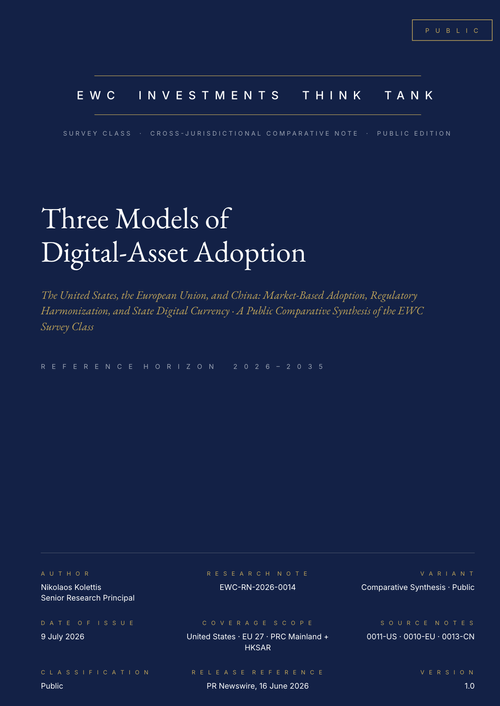
The United States, the European Union, and China: Market-Based Adoption, Regulatory Harmonization, and State Digital Currency
This public comparative synthesis from the EWC Think Tank examines three dominant jurisdictional approaches to digital assets: the United States, the European Union, and China. The research is not a simple ownership ranking. It is a comparative reading of institutional architecture: how each system absorbs, regulates, centralizes, or transmits digital-asset infrastructure.
The United States advances a market-based and expansionary model. The European Union advances a regulatory-harmonization model. China advances a state-controlled digital-currency model. Each model is coherent on its own terms, and each leads on the axis it optimizes: China in sovereign digital-currency scale, the European Union in regulatory uniformity, and the United States in market-based adoption and global transmissibility.
Europe builds legal certainty. China builds sovereign digital-money infrastructure. The United States integrates digital assets into public capital markets, corporate treasuries, regulated issuers, exchange-traded products, retirement channels, and dollar-based financial infrastructure. For that reason, the United States model has the strongest capacity to shape the global economy.
“The depth of institutional embedding is what distinguishes the United States. Digital assets there are being absorbed into the ordinary machinery of public finance, from exchange-traded funds to corporate treasuries and retirement allocation, and that integration is what allows an asset class to mature into a financial system.”
Nikolaos Kolettis · Founder of EWC Investments · Senior Research PrincipalThe Comparative Method
The note compares the three jurisdictions through five institutional axes. This avoids a false composite score and preserves the fact that each jurisdiction is optimizing a different objective function.
How far digital assets are absorbed into regulated market structure.
How uniform and predictable the legal perimeter is across the jurisdiction.
The operational scale of CBDC and state-directed settlement rails.
Adult ownership rates, demography, and observed adoption trajectory.
The model’s capacity to project beyond the home jurisdiction.
The Three Models
Market-Based Adoption
The U.S. model is private-market, expansionary, and externally transmissive. Digital assets enter the machinery of public finance through spot ETFs, corporate treasuries, regulated stablecoin issuers, public-company balance sheets, retirement channels, mining infrastructure, and dollar-linked global financial rails.
Regulatory Harmonization
The EU model is legally founded and rules-first. Its strength is not speed or market aggression, but the construction of a durable regulated perimeter through MiCA, DAC8, CASP authorization, tax transparency, consumer protection, and the prospective digital euro.
State Digital Currency
China’s model brings digital currency inside the state’s monetary and banking architecture. The e-CNY and state-directed settlement rails operate at scale, while mainland private cryptocurrency activity remains prohibited and Hong Kong functions as the regulated institutional interface.
Why the United States Has the Edge
The United States leads not because it is the only jurisdiction engaging with digital assets, but because it is the jurisdiction most capable of converting digital-asset adoption into liquid, investable, institutionally embedded financial infrastructure.
The European Union protects and harmonizes. China standardizes and centralizes. The United States absorbs, scales, and transmits through global markets. That is the core difference: American digital-asset adoption is not merely domestic; it is exported through the dollar system, public capital markets, exchange-traded products, regulated issuers, corporate balance sheets, and investor access.
The U.S. model therefore has the strongest global transmission capacity. Its capital markets are already global, its stablecoin infrastructure is dollar-linked, and its institutional channels are open to cross-border allocators. This is the axis on which the comparative conclusion turns.
“Europe is constructing a regulated perimeter and China a sovereign digital currency, and both are consequential achievements. The American model is the one in which private initiative and public capital markets reinforce one another at scale, and for that reason it remains the most globally transmissive.”
Nikolaos Kolettis · Founder of EWC Investments · Senior Research PrincipalResearch Basis and Independence
This synthesis is based on three completed EWC Survey-class research notes covering the United States, the European Union, and China. The synthesis reuses the verified figures and stated base-case assumptions from those notes and does not add new quantitative claims beyond the underlying research.
EWC Investments is an independent research house and was not commissioned, compensated, or directed by any issuer, trading platform, asset manager, or government in the preparation of this analysis. This release is provided for informational purposes only and does not constitute investment advice, a recommendation, an offer, or a solicitation to buy or sell any asset.
About EWC Investments
EWC Investments is an independent digital-finance research house based in Athens, Greece, producing institutional-grade analysis of digital assets, market structure, portfolio strategy, adoption architecture, and the long-term transformation of global financial markets.

EWC THINK TANK 2026
Research Outputs at a Glance
Six institutional lenses from Three Models of Digital-Asset Adoption: the United States as the market-based adoption model, the European Union as the regulatory-harmonization model, China as the state-controlled digital-currency model, and the comparative finding that external transmissibility favors the United States.

United States: Market-Based Model
The U.S. model is the most extroverted of the three: digital assets are absorbed into public capital markets, exchange-traded products, corporate treasuries, regulated stablecoin issuers, institutional custody, mining infrastructure, and retirement channels.

European Union: Regulatory Perimeter
The EU model is legally founded and rules-first. Its strength is the construction of a coherent regulated perimeter through MiCA, DAC8, CASP authorization, tax transparency, consumer protection, and the prospective digital euro.

China: State Digital Currency
China leads in state-driven digital-currency scale through the e-CNY and sovereign payment infrastructure, while mainland private cryptocurrency trading, mining, and unauthorized stablecoin activity remain prohibited.

Institutional Embedding
The American lead is not only a household-ownership statistic. It rests on depth: spot Bitcoin ETFs around $96.5 billion, public-company treasuries above one million BTC, retirement-channel opening, and federal stablecoin legislation.

Five-Axis Comparative Method
The research compares the three jurisdictions across institutional embedding, regulatory coherence, sovereign digital-currency scale, household participation, and external transmissibility, while refusing a false composite score.

Transmission Advantage
The core conclusion is that the U.S. model has the strongest global impact: Europe protects and harmonizes, China standardizes and centralizes, while the United States absorbs, scales, and transmits through global markets.
